
Fast and often cheaper, but less responsive to the actual condition of the vehicle.
Custom vs Generic
Custom dyno tuning vs generic remaps.
Most tuning adverts promise more power. The real difference is how the calibration is chosen, checked and corrected when the vehicle does not behave like a perfect example.
The Difference
A generic remap starts with an assumption. Custom tuning starts with the car.
A generic remap is usually based on a file or calibration expected to suit a broad type of vehicle. That can be quick and convenient, especially on a standard car in good condition. The risk is that the file may not account for mileage, hardware condition, previous software, clutch strength, DPF condition, fuel quality or modifications.
Custom dyno tuning should be more measured. The tuner checks the vehicle, watches data under load and adjusts the calibration around what the car is actually doing. That does not mean every vehicle gets a completely unique map from a blank screen. It means the final result is tested and corrected against evidence rather than assumed.
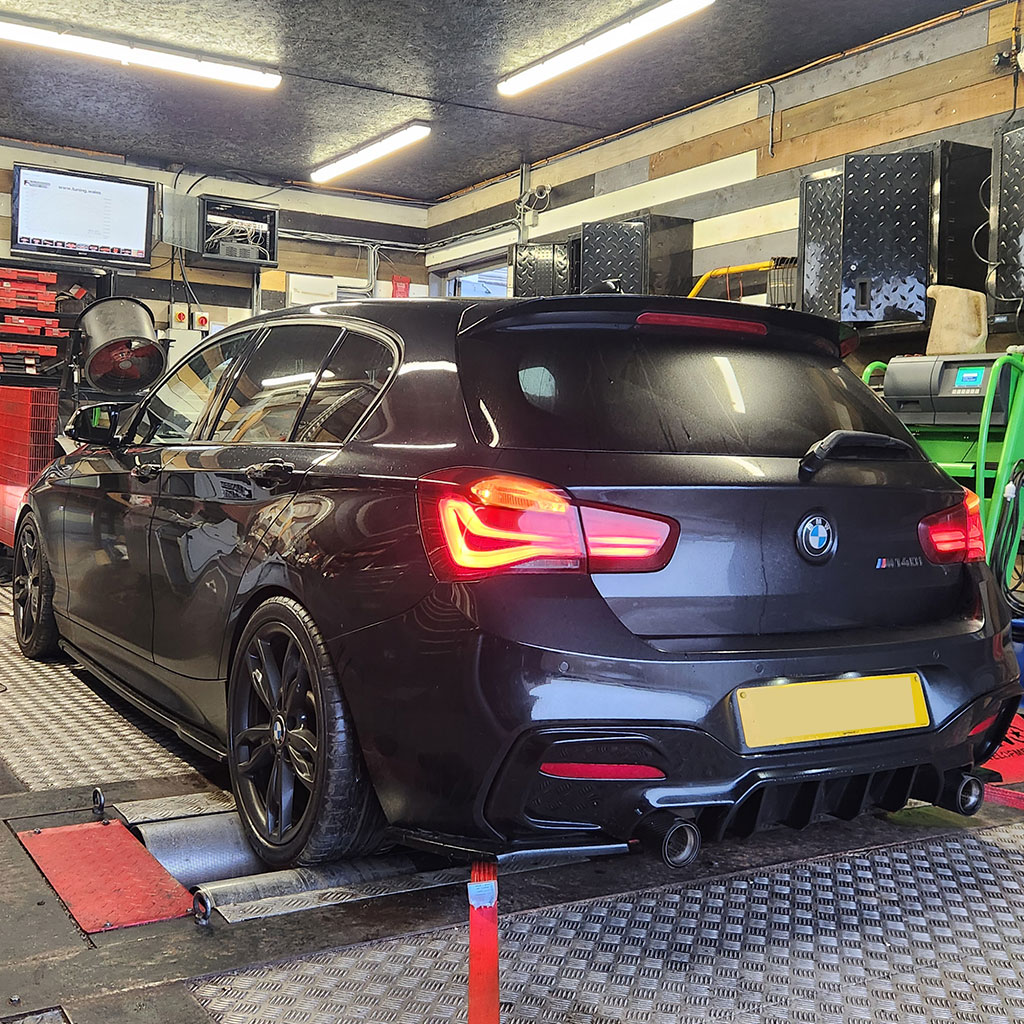
What Dyno Testing Adds
Controlled load reveals what a quick drive can miss.
A dyno lets the tuner hold and observe load in a repeatable way. That helps with boost control, fuelling, torque delivery, intake temperature, exhaust behaviour and clutch slip. It can also reveal that a vehicle should not be pushed further.
That last point matters. The purpose of a dyno should not be to force the biggest number out of the car. The useful purpose is to find a result that is strong, repeatable and appropriate for the vehicle. Sometimes the safer map is the better map.
It is also worth understanding what dyno proven really means, because some tuning claims refer to files developed on a dyno in the past rather than validation on the car in front of the tuner.
More time-consuming, but better suited to modified, older or problem vehicles.
Shows how the car behaves under load and whether the result is repeatable.
Gives the tuner a way to see boost, fuelling, temperatures and protection limits.
The tuner can stop, repair or lower targets instead of pushing through a fault.
A documented baseline makes later concerns easier to understand.
Balanced Comparison
When a generic remap may be enough.
A generic remap may be enough for a healthy, standard vehicle where the customer wants a modest improvement and the car has no warning lights, no previous tuning issues and no unusual hardware. In that situation, a proven baseline file can be a sensible route when it is sold honestly and the limits are clear.
For example, a low-mileage standard hatchback with no fault codes, no clutch symptoms and no hardware changes may respond predictably to a conservative pre-developed calibration. The key is that the driver understands what is being bought and does not confuse a generic file with full vehicle-specific development.
When custom dyno tuning matters more.
Custom dyno tuning matters more when the car is modified, high mileage, previously mapped, used hard, showing symptoms or expected to run close to hardware limits. In those cases, the value is not just the power gain; it is the checking, logging, adjustment and decision-making around the actual vehicle.
Custom work also matters when the first result is not the right result. If boost does not follow target, fuelling looks uneven, torque is too aggressive for the clutch, or intake temperatures rise too quickly, the tuner needs evidence and time to change direction.
Why modified and high-mileage cars need more care.
A modified petrol turbo may need boost control, fuelling, ignition timing and intake temperatures checked carefully because supporting hardware changes how the car behaves. A high-mileage diesel may need DPF pressure, injector correction, clutch slip and smoke levels checked before extra torque is requested.
Petrol example: A turbo petrol with an intake, exhaust and unknown previous software may need careful checks around knock control, fuelling, boost stability and ignition timing. A file that works on a standard car may not suit the modified setup without validation.
Diesel example: A high-mileage diesel may make strong torque easily, but the clutch, turbo control, DPF pressure and injector correction can limit what is sensible. A safer calibration may deliberately avoid the biggest possible number.
This is why the same advertised power gain can mean different things from different providers. One route may be a quick file applied to a broadly similar car. Another may include checks, measured data, revisions and a final decision based on how that specific vehicle behaves.
The buyer takeaway is to match the tuning route to the risk of the vehicle. Simple healthy cars may need less process. Problem cars, modified cars and cars with unknown history need more evidence.
For related search questions, read what dyno proven really means, dyno failure concerns and how to choose a tuner.
Buyer Advice
Ask what is included, not just what power is promised.
Before choosing a remap company, ask whether the price includes fault-code checks, logging, dyno testing, a printout, follow-up support and a clear explanation of the limits. If a tuner says every car gets the same result, be careful. Cars of the same model can behave very differently once mileage, servicing, parts and previous work are considered.
The best tuning decision is rarely the loudest one. It is the one backed by evidence, clear communication and enough restraint to avoid turning an already weak vehicle into an expensive problem. The tuner choice guide turns those points into a practical checklist.